Adi Shankaracharya aur Sachi Daata ki Shakti (Akshaya Tritiya Kahani)
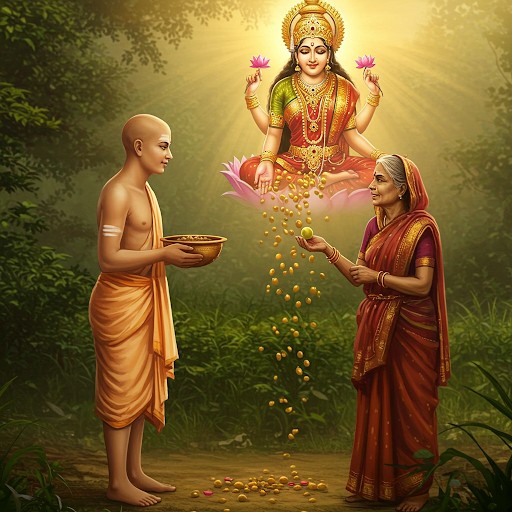
Ek baar Adi Shankaracharya, jo ek mahan darshanik aur sant the, Bharat yatra par nikle hue the taaki Advaita Vedanta ka sandesh phaila sakein. Apne safar ke dauraan, unki mulaqat ek bahut gareeb mahila se hui, jiske paas dene ke liye sirf ek amla (aawla) tha.
Phir bhi, us mahila ne apne poore shraddha aur prem ke saath woh amla Adi Shankaracharya ko arpan kiya.
Shankara unki nishkaam daanbhavna se itne prabhavit hue ki unhone Kanaka Dhara Stotra naam ka ek divya stotra rachit kiya — jo Lakshmi Mata ko samarpit tha.
Unki bhakti aur stuti se prasan hoke, Devi Lakshmi prakat hui aur us mahila ke ghar mein sunehre aawle ki varsha kar di. Tab se us mahila ka ghar sukh-samriddhi se bhar gaya.
Aisa kaha jata hai ki yeh ghatna Akshaya Tritiya ke din ghati thi — ek aisa pavitra din jab sachche daan aur bhakti ke phal kabhi samaapt nahi hote.
Adi Shankara and the Power of True Giving (Akshaya Tritiya Story)
Once, Adi Shankaracharya was traveling across India to spread the message of Advaita Vedanta. During his journey, he came across a poor woman who had nothing but a single gooseberry (amla) in her house. Still, she offered it to Shankara with devotion.
Adi Shankara was deeply moved by her selfless giving, even in extreme poverty. In response, he composed a powerful Sanskrit hymn called Kanaka Dhara Stotra — a prayer to Goddess Lakshmi, the goddess of wealth.
Pleased by Shankara’s heartfelt prayer and the woman’s devotion, Goddess Lakshmi appeared and showered her home with golden gooseberries, symbolizing unending prosperity. From that moment, the woman’s poverty vanished, and her household flourished.
This event is said to have taken place on Akshaya Tritiya, the day when good deeds, charity, and devotion lead to “Akshaya” (eternal, unending) blessings.
Glossary
Adi Shankaracharya aur Sachi Daata ki Shakti (Akshaya Tritiya Kahani)
aur: and
Sachi: True
Daata: Giver / Charity / Giving
ki: of
Shakti: Power
(Akshaya Tritiya Kahani): (Akshaya Tritiya Story)
(Meaning: Adi Shankara and The Power of True Giving (Akshaya Tritiya Story))
Sentence 1:
"Ek baar Adi Shankaracharya, jo ek mahan darshanik aur sant the, Bharat yatra par nikle hue the taaki Advaita Vedanta ka sandesh phaila sakein."
Ek baar: Once
jo: who
ek mahan darshanik: a great philosopher
aur sant: and saint
the: was
Bharat yatra par: on a journey across India
nikle hue the: had gone / had set out
taaki: so that
Advaita Vedanta ka sandesh: message of Advaita Vedanta (non-dualism philosophy)
phaila sakein: could spread
(Meaning: Once, Adi Shankaracharya, who was a great philosopher and saint, was on a journey across India to spread the message of Advaita Vedanta.)
Sentence 2:
"Apne safar ke dauraan, unki mulaqat ek bahut gareeb mahila se hui, jiske paas dene ke liye sirf ek amla (aawla) tha."
Apne safar ke dauraan: During his journey
unki mulaqat: he met / his meeting happened
ek bahut gareeb mahila: a very poor woman
se hui: took place with
jiske paas: who had
dene ke liye: to give
sirf: only
ek amla (aawla): one gooseberry
tha: was
(Meaning: During his journey, he met a very poor woman who had only one gooseberry to offer.)
Sentence 3:
"Phir bhi, us mahila ne apne poore shraddha aur prem ke saath woh amla Adi Shankaracharya ko arpan kiya."
Phir bhi: Even then / Still
us mahila ne: that woman
apne poore shraddha: with her full devotion
aur prem ke saath: and with love
woh amla: that gooseberry
Adi Shankaracharya ko: to Adi Shankaracharya
arpan kiya: offered
(Meaning: Still, that woman offered the gooseberry to Adi Shankara with full devotion and love.)
Sentence 4:
"Shankara unki nishkaam daanbhavna se itne prabhavit hue ki unhone Kanaka Dhara Stotra naam ka ek divya stotra rachit kiya — jo Lakshmi Mata ko samarpit tha."
Shankara: Shankaracharya
unki nishkaam daanbhavna: her selfless attitude of giving
se itne prabhavit hue: was so affected / impressed by
ki: that
unhone: he
Kanaka Dhara Stotra: (name of the hymn, means "Golden Stream Prayer")
naam ka: named
ek divya stotra: a divine hymn
rachit kiya: composed
jo Lakshmi Mata ko samarpit tha: which was dedicated to Goddess Lakshmi
(Meaning: Shankara was so touched by her selfless generosity that he composed a divine hymn called Kanaka Dhara Stotra — dedicated to Goddess Lakshmi.)
Sentence 5:
"Unki bhakti aur stuti se prasan hoke, Devi Lakshmi prakat hui aur us mahila ke ghar mein sunehre aawle ki varsha kar di."
Unki bhakti: His devotion
aur stuti se: and through praise
prasan hoke: becoming pleased
Devi Lakshmi prakat hui: Goddess Lakshmi appeared
aur: and
us mahila ke ghar mein: in that woman's home
sunehre aawle ki varsha kar di: showered golden gooseberries
(Meaning: Pleased by his devotion and prayer, Goddess Lakshmi appeared and showered golden gooseberries in the woman’s home.)
Sentence 6:
"Tab se us mahila ka ghar sukh-samriddhi se bhar gaya."
Tab se: Since then
us mahila ka ghar: that woman’s house
sukh-samriddhi: happiness and prosperity
se bhar gaya: got filled
(Meaning: From then on, the woman’s house was filled with happiness and prosperity.)
Sentence 7:
"Aisa kaha jata hai ki yeh ghatna Akshaya Tritiya ke din ghati thi — ek aisa pavitra din jab sachche daan aur bhakti ke phal kabhi samaapt nahi hote."
Aisa kaha jata hai: It is said
ki yeh ghatna: that this incident
Akshaya Tritiya ke din: on the day of Akshaya Tritiya
ghati thi: had occurred
ek aisa pavitra din: a sacred day like this
jab: when
sachche daan aur bhakti ke phal: the fruits of true giving and devotion
kabhi samaapt nahi hote: never end / never cease
(Meaning: It is said that this event happened on Akshaya Tritiya — a sacred day when true charity and devotion bring never-ending rewards.)