Deepavali kyon manayi jati hai?
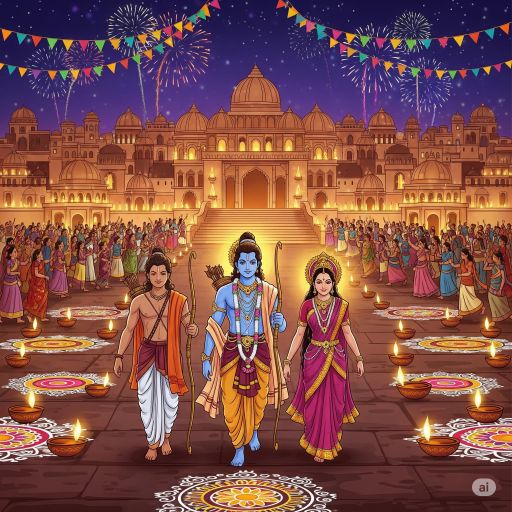
Bohut samay pehle ki baat hai, ek shaktishaali raakshas raja tha jiska naam tha Ravana. Wah bohut taakatwar tha aur Lanka par raaj karta tha, lekin wah atyachaari aur lalchi bhi tha. Ek din usne Sita ko, jo ki Rajkumar Rama ki patni thi, apharan kar liya aur Lanka le gaya.
Rama, apne bhai Lakshmana aur vanar devta Hanuman ki madad se, Sita ko bachane ke liye ek lambi aur veer yudh lada. 14 saal ka vanvaas poora karne ke baad aur kathin yudh ke baad, Rama ne ant mein Ravana ko hara diya aur Sita ko wapas Ayodhya le aaye.
Ayodhya ke log bahut khush hue! Rama, Sita aur Lakshmana ke swagat ke liye, unhone diye jalaye aur poore sheher ko roshni se bhar diya. Pura rajya khushi aur ujjwalta se chamak utha. Wahi din Deepavali ke roop mein manaya gaya, jiska arth hota hai "deepo ki pankti".
Vah din Deepavali ke naam se jaana gaya, jiska arth hai "roshni ki pankti."
Tab se log har saal Deepavali manate hain:
- Diye aur candles jala kar
- Apne ghar sajakar
- Patakhe chodkar
- Mithaiyaan baant kar
- Naye kapde pehan kar
Yeh tyohar bure par acche ki jeet, andhkaar par prakash ki vijay, aur nirasha par aasha ki jeet ka prateek hai.
Why Deepavali is celebrated?
A long time ago, there was a powerful demon king named Ravana. He was very strong and ruled over Lanka, but he was also cruel and greedy. One day, he kidnapped Sita, the wife of Prince Rama, and took her to his kingdom.
Rama, with the help of his brother Lakshmana and the monkey god Hanuman, fought a long and brave battle to rescue Sita. After 14 years of exile and a fierce war, Rama finally defeated Ravana and brought Sita back home to Ayodhya.
The people of Ayodhya were overjoyed! To welcome Rama, Sita, and Lakshmana, they lit oil lamps (diyas) all around the city. The whole kingdom glowed with happiness and light. That day became known as Deepavali, which means “row of lights.”
Since then, people celebrate Deepavali every year by:
- Lighting diyas and candles
- Decorating their homes
- Bursting firecrackers
- Sharing sweets
- Wearing new clothes
It is a celebration of good over evil, light over darkness, and hope over despair.
Glossary
"Deepavali kyon manayi jati hai?"
Kyon: Why
Manayi: Celebrated/Observed
Jati Hai: Is done/Happens
(Meaning: Why Deepavali is celebrated?)
Sentence 1:
"Bohut samay pehle ki baat hai, ek shaktishaali raakshas raja tha jiska naam tha Ravana."
Bohut: Very
Samay: Time
Pehle: Before/Ago
Baat hai: It is a story/it's about
Ek: One
Shaktishaali: Powerful
Raakshas: Demon
Raja: King
Tha: Was
Jiska naam tha: Whose name was
(Meaning: A long time ago, there was a powerful demon king named Ravana.)
Sentence 2:
"Wah bohut taakatwar tha aur Lanka par raaj karta tha, lekin wah atyachaari aur lalchi bhi tha."
Wah: He
Bohut: Very
Taakatwar: Strong
Aur: And
Par: Over
Raaj karta tha: Ruled
Lekin: But
Atyachaari: Cruel
Lalchi: Greedy
Bhi: Also
Tha: Was
(Meaning: He was very strong and ruled over Lanka, but he was also cruel and greedy.)
Sentence 3:
"Ek din usne Sita ko, jo ki Rajkumar Rama ki patni thi, apharan kar liya aur Lanka le gaya."
Ek din: One day
Usne: He
Sita ko: Sita
Jo ki: Who
Rajkumar: Prince
Patni: Wife
Thi: Was
Apharan kar liya: Kidnapped
Aur: And
Le gaya: Took to
(Meaning: One day, he kidnapped Sita, who was Prince Rama’s wife, and took her to Lanka.)
Sentence 4:
"Rama, apne bhai Lakshmana aur vanar devta Hanuman ki madad se, Sita ko bachane ke liye ek lambi aur veer yudh lada."
Apne bhai: His brother
Aur: And
Vanar devta: Monkey god
Hanuman ki: Hanuman's
Madad se: With help
Bachane ke liye: To save/Rescue
Ek lambi: A long
Aur veer: And brave
Yudh: War/Battle
Lada: Fought
(Meaning: Rama, with the help of his brother Lakshmana and the monkey god Hanuman, fought a long and brave battle to rescue Sita.)
Sentence 5:
"14 saal ka vanvaas poora karne ke baad aur kathin yudh ke baad, Rama ne ant mein Ravana ko hara diya aur Sita ko wapas Ayodhya le aaye."
Saal ka: Years of
Vanvaas: Exile
Poora karne ke baad: After completing
Aur: And
Kathin: Difficult
Yudh ke baad: After the war/battle
Ant mein: In the end/finally
Hara diya: Defeated
Aur: And
Wapas: Back
Ayodhya le aaye: Brought back to Ayodhya
(Meaning: After completing 14 years of exile and a difficult battle, Rama finally defeated Ravana and brought Sita back to Ayodhya.)
Sentence 6:
"Ayodhya ke log bahut khush hue!"
Log: People
Ayodhya ke log: People of Ayodhya
Bahut: Very
Khush: Happy
Khush hue: Were happy/became happy
(Meaning: The people of Ayodhya were very happy!)
Sentence 7:
"Rama, Sita aur Lakshmana ke swagat ke liye, unhone diye jalaye aur poore sheher ko roshni se bhar diya."
Rama, Sita aur Lakshmana ke: Of Rama, Sita and Lakshmana
Swagat: Welcome
Swagat ke liye: To welcome
Unhone: They
Diya: A small oil lamp made of clay
Diye jalaye: Lit lamps
Aur: And
Sheher: City
Poore: The whole
Poore sheher ko: The whole city
Roshni: Light
Roshni se: With light
Bhar diya: Filled
(Meaning: To welcome Rama, Sita, and Lakshmana, they lit lamps and filled the whole city with light.)
Sentence 8:
"Pura rajya khushi aur ujjwalta se chamak utha."
Pura rajya: Entire kingdom
Khushi: Happiness
Aur: And
Ujjwalta: Brightness/light
Chamak: Glow
Se chamak utha: Sparkled with
(Meaning: The entire kingdom sparkled with happiness and brightness.)
Sentence 9:
"Wahi din Deepavali ke roop mein manaya gaya, jiska arth hota hai "deepo ki pankti"."
Wahi din: That very day
Deepavali ke roop mein: In the form of / as Deepavali
Manaya gaya: Was celebrated
Jiska arth hota hai: Which means
Deepo ki pankti: Row of lamps
(Meaning: That day was celebrated as Deepavali, which means “row of lights.”)
Sentence 10:
"Tab se log har saal Deepavali manate hain:"
Tab se: Since then
Log: People
Har saal: Every year
Deepavali manate hain: Celebrate Deepavali
(Meaning: Since then, people celebrate Deepavali every year:)
Sentence 11:
Diye jala kar
Diye: Oil lamps
Jala kar: By lighting
(Meaning: By lighting lamps)
Sentence 12:
Apne ghar sajakar
Apne: Their
Ghar: Homes
Sajakar: By decorating
(Meaning: By decorating their homes)
Sentence 13:
Patakhe chodkar
Patakhe: Firecrackers
Chodkar: By bursting
(Meaning: By bursting firecrackers)
Sentence 14:
Mithaiyaan baant kar
Mithaiyaan: Sweets
Baant kar: By sharing
(Meaning: By sharing sweets)
Sentence 15:
Naye kapde pehan kar
Naye: New
Kapde: Clothes
Pehan kar: By wearing
(Meaning: By wearing new clothes)
Sentence 16:
"Yeh tyohar bure par acche ki jeet, andhkaar par prakash ki vijay, aur nirasha par aasha ki jeet ka prateek hai."
Tyohar: Festival
Yeh tyohar: This festival
Bure par acche ki jeet: Victory of good over evil
Andhkaar: Darkness
Prakash: Light
Vijay: Victory
Andhkaar par prakash ki vijay: Victory of light over darkness
Nirasha: Despair
Aasha: Hope
Jeet: Victory
Nirasha par aasha ki jeet: Victory of hope over despair
Prateek: Sign/Symbol
Prateek hai: Is a symbol
(Meaning: This festival is a symbol of victory of good over evil, light over darkness, and hope over despair.)