Mahabali ki Wapsi
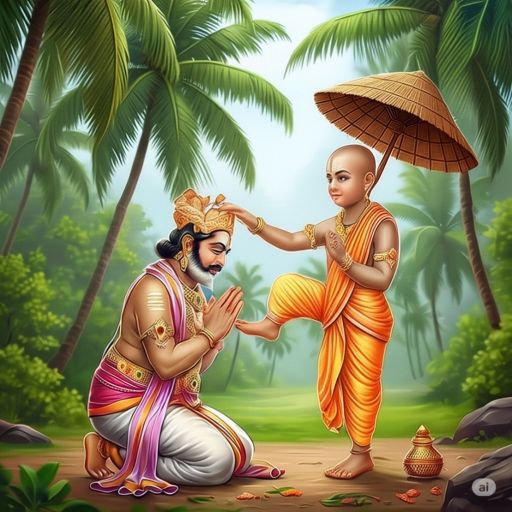
Bohot samay pehle, hara-bhara Kerala ek dayalu aur nyaypri king Mahabali ke raaj mein khushhaal tha. Raja apne logon se bohot pyaar karta tha aur sabko barabar maantaa tha. Uske raaj mein na koi dukh tha, na bhukh, na anyay. Sab log khush the.
Swarg ke devta ise dekh kar jalan mehsoos karne lage. “Ek insaan hote hue bhi log ise humse zyada pyaar karte hain,” unhone kaha. Lekin Bhagwan Vishnu ne Mahabali ki bhakti aur dayalu swabhav ko dekha aur use parakhna chaha.
Bhagwan Vishnu ek chhote Brahmin ladke Vamana ka roop lekar Mahabali ke paas aaye. Mahabali ne unka swaagat kiya aur kaha, “Mujhse jo chaho maang lo.”
Vamana ne kaha, “Mujhe sirf teen kadam zameen chahiye.”
Sab hasne lage — itni chhoti si maang! Lekin jaise hi Mahabali ne haan kaha, Vamana badhne lage. Wo itne bade ho gaye ki unka ek kadam aasman, doosra kadam poori dharti par pad gaya.
Phir Vamana bole, “Ab mera teesra kadam kahan rakhoon?”
Mahabali jhuk gaye aur bole, “Mere sir par rakhiye, Prabhu.”
Vamana ne apna paav dhire se Mahabali ke sir par rakha aur use paatal lok bhej diya. Lekin Mahabali ki vinamrata se prabhavit hoke, Vishnu ne usse ek vardaan diya — ki wo har saal ek din apne logon se milne Kerala wapas aa sakta hai.
Isi wapsi ka tyohaar hai Onam!
Har saal log phoolon se sajawat, boat race, sangeet, naach, aur bhoj ke saath Mahabali ka swaagat karte hain, taki wo dekhe ki unka Kerala ab bhi sundar aur khushhaal hai.
Seekh: Saccha mahan vyakti wahi hota hai jisme vinamrata aur dusron ke liye prem hota hai.
The Return of Mahabali
Long ago in the lush green land of Kerala, there lived a kind and noble king named Mahabali. He loved his people dearly and ruled with fairness and peace. Under his rule, there was no sorrow, no crime, and no hunger. People were happy, and prosperity bloomed everywhere.
But the gods in heaven grew jealous. “Mahabali is just a human, yet people love him more than us,” they murmured. Lord Vishnu, however, saw the king’s goodness and decided to test him.
He took the form of a tiny Brahmin boy named Vamana and visited Mahabali during a grand festival. The king welcomed him warmly and said, “Ask me anything you wish.”
Vamana smiled and said, “I need only three feet of land.”
The courtiers laughed — such a small request! But as soon as Mahabali agreed, Vamana began to grow. He grew taller and taller, towering above the clouds. With one foot, he covered the sky. With the second, he stepped over the earth.
“Where should I place my third step?” Vamana asked.
Mahabali bowed and said, “On my head, Lord.”
Vamana placed his foot gently on Mahabali's head and pushed him to the underworld. But touched by Mahabali’s humility, Vishnu granted him a special boon — once a year, Mahabali could return to Kerala to visit his people.
And that homecoming is celebrated as Onam!
Every year, the people of Kerala welcome King Mahabali with flower carpets, boat races, music, dance, and delicious feasts, hoping to show him that his land is still just as beautiful and joyful.
Moral: True greatness lies in humility and love for others.
Glossary
Sentence 1:
"Bohot samay pehle, hara-bhara Kerala ek dayalu aur nyaypri king Mahabali ke raaj mein khushhaal tha.
Bohot samay pehle: A long time ago
Hara-bhara: Lush green
Kerala: A state in southern India
Dayalu: Kind
Nyaypri (nyayapriya): Just/fair
Raaj: Rule/reign
Khushhaal: Prosperous/happy
Meaning: A long time ago, lush green Kerala was prosperous under the rule of the kind and fair King Mahabali.
Sentence 2:
"Raja apne logon se bohot pyaar karta tha aur sabko barabar maantaa tha."
Raja: King
Apne logon se: With his people
Bohot pyaar karta tha: Loved very much
Sabko barabar maantaa tha: Treated everyone equally
Meaning: The king loved his people and treated everyone equally.
Sentence 3:
"Uske raaj mein na koi dukh tha, na bhukh, na anyay. Sab log khush the."
Uske raaj mein: In his rule
Dukh: Sorrow
Bhukh: Hunger
Anyay: Injustice
Sab log khush the: Everyone was happy
Meaning: In his kingdom, there was no sorrow, no hunger, and no injustice. Everyone was happy.
Sentence 4:
"Swarg ke devta ise dekh kar jalan mehsoos karne lage."
Swarg: Heaven
Devta: Gods
Jalan: Jealousy
Mehsoos karne lage: Began to feel
Meaning: The gods in heaven began to feel jealous seeing this.
Sentence 5:
"Ek insaan hote hue bhi log ise humse zyada pyaar karte hain,” unhone kaha."
Insaan: Human
Hote hue bhi: Even though he was
Zyada: More
Pyaar karte hain: Love
Unhone kaha: They said
Meaning: "Even though he is just a human, people love him more than us," they said.
Sentence 6:
"Lekin Bhagwan Vishnu ne Mahabali ki bhakti aur dayalu swabhav ko dekha aur use parakhna chaha."
Lekin: But
Bhagwan: God
Bhakti: Devotion
Dayalu: Kind
Swabhav: Nature
Parakhna chaha: Wanted to test
Meaning: But Lord Vishnu saw Mahabali's devotion and kind nature and decided to test him.
Sentence 7:
"Bhagwan Vishnu ek chhote Brahmin ladke Vamana ka roop lekar Mahabali ke paas aaye."
Chhote: Small
Brahmin: Priest caste
Ladke: Boy
Roop lekar: Taking the form
Paas aaye: Came near/to him
Meaning: Lord Vishnu came to Mahabali in the form of a small Brahmin boy named Vamana.
Sentence 8:
"Mahabali ne unka swaagat kiya aur kaha, 'Mujhse jo chaho maang lo.'"
Swaagat kiya: Welcomed
Kaha: Said
Mujhse jo chaho maang lo: Ask me for whatever you want
Meaning: Mahabali welcomed him and said, “Ask me for whatever you wish.”
Sentence 9:
"Vamana ne kaha, 'Mujhe sirf teen kadam zameen chahiye.'"
Sirf: Only
Teen kadam: Three steps
Zameen: Land
Chahiye: Want/need
Meaning: Vamana said, “I only want three steps of land.”
Sentence 10:
"Sab hasne lage — itni chhoti si maang!"
Sab: Everyone
Hasne lage: Started laughing
Chhoti si maang: Such a small request
Meaning: Everyone started laughing — such a small request!
Sentence 11:
"Lekin jaise hi Mahabali ne haan kaha, Vamana badhne lage."
Haan kaha: Said yes
Badhne lage: Started growing
Meaning: But as soon as Mahabali said yes, Vamana began to grow.
Sentence 12:
"Wo itne bade ho gaye ki unka ek kadam aasman, doosra kadam poori dharti par pad gaya."
Itne bade ho gaye: Became so big
Ek kadam: One step
Aasman: Sky
Doosra kadam: Second step
Dharti: Earth
Pad gaya: Landed
Meaning: He grew so huge that one step covered the sky and the second covered the earth.
Sentence 13:
"Phir Vamana bole, 'Ab mera teesra kadam kahan rakhoon?'"
Phir: Then
Bole: Said
Teesra kadam: Third step
Kahan rakhoon: Where should I place
Meaning: Then Vamana said, “Where should I place my third step?”
Sentence 14:
"Mahabali jhuk gaye aur bole, 'Mere sir par rakhiye, Prabhu.'"
Jhuk gaye: Bowed down
Bole: Said
Mere sir par rakhiye: Place it on my head
Prabhu: Lord
Meaning: Mahabali bowed and said, “Place it on my head, Lord.”
Sentence 15:
"Vamana ne apna paav dhire se Mahabali ke sir par rakha aur use paatal lok bhej diya."
Paav: Foot
Dhire se: Gently
Paatal lok: Underworld
Bhej diya: Sent
Meaning: Vamana gently placed his foot on Mahabali’s head and sent him to the underworld.
Sentence 16:
"Lekin Mahabali ki vinamrata se prabhavit hoke, Vishnu ne usse ek vardaan diya."
Vinamrata: Humility
Prabhavit hoke: Being impressed
Vardaan: Boon/blessing
Meaning: But impressed by Mahabali’s humility, Vishnu gave him a boon.
Sentence 17:
"Ki wo har saal ek din apne logon se milne Kerala wapas aa sakta hai."
Har saal: Every year
Ek din: One day
Milne: To meet
Wapas aa sakta hai: Can return
Meaning: That he could return to Kerala once a year to meet his people.
Sentence 18:
"Isi wapsi ka tyohaar hai Onam!"
Wapsi: Return
Tyohaar: Festival
Meaning: That return is celebrated as the festival of Onam!
Sentence 19:
"Har saal log phoolon se sajawat, boat race, sangeet, naach, aur bhoj ke saath Mahabali ka swaagat karte hain."
Phoolon se sajawat: Flower decorations
Boat race: Boat races
Sangeet: Music
Naach: Dance
Bhoj: Feast/banquet
Swaagat karte hain: Welcome
Meaning: Every year, people welcome Mahabali with flowers, boat races, music, dance, and feasts.
Sentence 20:
"Taki wo dekhe ki unka Kerala ab bhi sundar aur khushhaal hai."
Taki: So that
Dekhe: He can see
Sundar: Beautiful
Khushhaal: Prosperous
Meaning: So that he sees his Kerala is still beautiful and prosperous.