Narasimha Ki Kahani
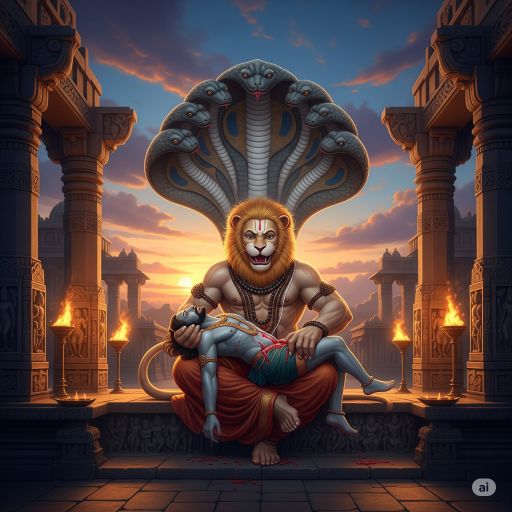
Ek samay ek asur raja tha jiska naam Hiranyakashipu tha. Usne teenon lokon par apna kabza kar liya tha. Usne Bhagwan Brahma se ek vardaan ki prarthana ki. Vardaan yeh tha ki uski mrityu kisi bhi astra-shastra se na ho, na to ghar ke andar aur na bahar, na to kisi manushya se aur na hi kisi pashu se, na hi dharti par, na hi aakash mein aur na hi paani mein, aur na hi din mein aur na hi raat mein. Bhagwan Brahma ne usse yeh vardaan de diya. Uske baad, Bhagwan Vishnu ke anugrah se uske ghar ek putra hua jo Bhagwan ka atyant bhakt tha, uska naam tha Prahalad. Hiranyakashipu ko yeh pasand nahi tha ki Prahalad hamesha Bhagwan Vishnu ka naam japta rahe. Kyunki Prahalad ne kabhi bhi Bhagwan Vishnu ka naam japna nahi chhoda, isliye Hiranyakashipu usse maarna chahta tha. Sabse pehle usne use pahaad se dhakka dene ki koshish ki. Phir apni behen Holika ko kaha ki vah Prahalad ko god mein lekar agni mein baithe, socha ki Prahalad jal jaayega. Lekin Holika jal gayi aur Prahalad ko kuchh nahi hua. Isi ghatna ko aaj bhi Holi ke roop mein manaya jaata hai. Prahalad ne Hiranyakashipu se kaha: "Jab bhi aap mujhe maarne ki koshish karte hain to safal nahi hote, kyunki mere pita Bhagwan Vishnu mujhe bachate hain. Vah sarvavyapi hain, har jagah hain. Isliye aap kahin bhi koshish karenge, safalta nahi milegi." Tab Hiranyakashipu ne gusse mein kaha: "Agar vah har jagah hain to kya us khambe mein bhi hain?" Prahalad ne kaha: "Haan." Tab Hiranyakashipu ne khambe ko toda, aur usmein se Bhagwan Narasimha prakat huye. Phir Narasimha aur Hiranyakashipu ke beech ek bhayanak yudh hua jo bahut der tak chala. Ant mein, Narasimha ne Hiranyakashipu ko mahal ke dwar par le jaakar, use apni godh mein bithaya, suryast ke samay apne teekhe nakhon se uska ant kar diya. Yeh hai kahani Bhagwan Narasimha ki, jo Bhagwan Vishnu ke chauthe avatar the.
Story of Narasimha
There was a demon king by name Hiranyakashipu. He had taken over all the three worlds. He prayed to Lord Brahma for a boon. The boon is that he will not die by any weapon, not inside his home or outside, he cannot be killed by any human or animal, he cannot be killed in earth, sky and water, not during the day and not during the night. Lord Brahma had granted him the boon. Then Lord Vishnu had given a son who was very devoted to Lord by name Prahalada. Hiranyakashipu did not like Prahalada chanting the name of Lord Vishnu all the time. Since Prahalada never stopped chanting Lord Vishnu's name, Hiranyakashipu wanted to kill him. He first tried pushing him off a cliff. Then asked his sister Holika to sit in the fire with him thinking he would burn. Holika got burnt but nothing happened to Prahalada. This event is celebrated as Holi. Prahalada told Hiranyakashipu that every time you try to kill me you do not succeed because Lord Vishnu is protecting me as he is the supreme father and he is all around. So wherever you do it you will not succeed. Then Hiranyakashipu said if he is all around is he is in that pillar. Then Prahalada said yes. So Hiranyakashipu broke the pillar and then came Lord Narasimha. The Epic battle between Narasimha and Hiranyakashipu went on for a long time. Then Narasimha took Hiranyakashipu to the entrance of the palace, placed him on his lap at sunset and killed him by pushing his sharp nails into him. This is the story of Lord Narasimha, the fourth avatar of Lord Vishnu.
Glossary
"Narasimha Ki Kahani"
Ki: Of
Kahani: Story
Translation: Story of Narasimha
Sentence 1:
"Ek samay ek asur raja tha jiska naam Hiranyakashipu tha."
Ek: One/once
Samay: Time
Ek: One/a
Asur: Demon
Raja: King
Tha: Was
Jiska: Whose
Naam: Name
Tha: Was
Translation: Once there was a demon king whose name was Hiranyakashipu.
Sentence 2:
"Usne teenon lokon par apna kabza kar liya tha."
Usne: He
Teenon: All three
Lokon: Worlds
Par: Over/upon
Apna: His own
Kabza: Control/possession
Kar liya tha: Had taken
Translation: He had taken control over all the three worlds.
Sentence 3:
"Usne Bhagwan Brahma se ek vardaan ki prarthana ki."
Usne: He
Bhagwan: Lord
Brahma: Brahma
Se: From / to
Ek: One
Vardaan: Boon
Ki: Of
Prarthana: Prayer
Ki: Did
Translation: He prayed to Lord Brahma for a boon.
Sentence 4:
"Vardaan yeh tha ki uski mrityu kisi bhi astra-shastra se na ho, na to ghar ke andar aur na bahar, na to kisi manushya se aur na hi kisi pashu se, na hi dharti par, na hi aakash mein aur na hi paani mein, aur na hi din mein aur na hi raat mein."
Vardaan yeh tha: The boon was this
Ki: That
Uski: His
Mrityu: Death
Kisi bhi: By any
Astra-shastra: Weapon
Se na ho: Should not be
Na to: Neither
Aur na: Nor
Ghar: House
Andar: Inside
Ghar ke andar: Inside the house
Bahar: Outside
Kisi manushya se: By any human
Aur na hi: And not even
Kisi pashu se: By any animal
Na hi: Nor
Dharti par: On earth
Aakash: Sky
Aakash mein: In the sky
Paani: Water
Paani mein: In water
Din: Day
Din mein: In day
Raat: Night
Raat mein: In night
Translation: The boon was that his death should not be caused by any weapon, not inside the house nor outside, not by any human nor animal, not on earth, nor in sky, nor in water, and neither in day nor in night.
Sentence 5:
"Bhagwan Brahma ne usse yeh vardaan de diya."
Bhagwan: Lord
Bhagwan Brahma: Lord Brahma
Usse: To him
Yeh: This
Vardaan: Boon
De diya: Gave
Translation: Lord Brahma granted him this boon.
Sentence 6:
"Uske baad, Bhagwan Vishnu ke anugrah se uske ghar ek putra hua jo Bhagwan ka atyant bhakt tha, uska naam tha Prahalad."
Uske baad: After that
Anugrah: Grace
Bhagwan Vishnu ke anugrah se: By the grace of Lord Vishnu
Ghar: House
Uske ghar: In his house
Putra: Son
Ek putra hua: A son was born
Jo: Who
Bhagwan ka: Of the Lord
Atyant: Very/extremely
Bhakt: Devotee
Bhakt tha: Was a devotee
Naam: Name
Uska naam tha Prahalad: His name was Prahalad
Translation: After that, by the grace of Lord Vishnu, a son was born in his house who was a great devotee of the Lord; his name was Prahalad.
Sentence 7:
"Hiranyakashipu ko yeh pasand nahi tha ki Prahalad hamesha Bhagwan Vishnu ka naam japta rahe."
Pasand: Like
Ki: That
Hamesha: Always
Naam: Name
Japta rahe: Kept chanting
Translation: Hiranyakashipu did not like that Prahalad always kept chanting the name of Lord Vishnu.
Sentence 8:
"Kyunki Prahalad ne kabhi bhi Bhagwan Vishnu ka naam japna nahi chhoda, isliye Hiranyakashipu usse maarna chahta tha."
Kyunki: Because
Kabhi bhi: Ever/never
Nahi chhoda: Did not stop
Isliye: Therefore
Usse: Him
Maarana: Kill
Maarna chahta tha: Wanted to kill
Translation: Because Prahalad never stopped chanting Lord Vishnu’s name, Hiranyakashipu wanted to kill him.
Sentence 9:
"Sabse pehle usne use pahaad se dhakka dene ki koshish ki."
Sabse pehle: First of all
Usne: He
Use: Him
Pahaad: Mountain
Dhakka: Push
Koshish : Try
Translation: First, he tried to push him off a mountain.
Sentence 10:
"Phir apni behen Holika ko kaha ki vah Prahalad ko god mein lekar agni mein baithe, socha ki Prahalad jal jaayega."
Phir: Then
Apni: His
Behen: Sister
Kaha: Told
Ki: That
Vah: She
God mein lekar: Taking in her lap
Agni: Fire
Baithe: Should sit
Socha: Thought
Ki: That
Translation: Then he told his sister Holika to sit in fire with Prahalad in her lap, thinking Prahalad would burn.
Sentence 11:
"Lekin Holika jal gayi aur Prahalad ko kuchh nahi hua."
Lekin: But
Jal gayi: Got burnt
Aur: And
Kuchh nahi hua: Nothing happened
Translation: But Holika got burnt and nothing happened to Prahalad.
Sentence 12:
"Isi ghatna ko aaj bhi Holi ke roop mein manaya jaata hai."
Ghatna: Event
Aaj bhi: Even today
Holi ke roop mein: In the form of Holi
Manaya: Celebrated
Manaya jaata hai: Is celebrated
Translation: This event is even today celebrated as Holi.
Sentence 13:
"Prahalad ne Hiranyakashipu se kaha: 'Jab bhi aap mujhe maarne ki koshish karte hain to safal nahi hote, kyunki mere pita Bhagwan Vishnu mujhe bachate hain.'"
Jab bhi: Whenever
Aap: You
Mujhe: Me
Safal: Success
Kyunki: Because
Mere: My
Pita: Father
Bachate: Protect
Translation: Prahalad said to Hiranyakashipu: "Whenever you try to kill me, you do not succeed, because my father Lord Vishnu protects me."
Sentence 14:
"Vah sarvavyapi hain, har jagah hain. Isliye aap kahin bhi koshish karenge, safalta nahi milegi."
Vah: He
Sarvavyapi: All-pervading/everywhere
Jagah: Place
Isliye: Therefore
Aap: You
Kahin bhi: Anywhere
Koshish: Try
Safalta: Success
Milegi: Will get
Translation: He is everywhere, so wherever you try, you will not succeed.
Sentence 15:
"Tab Hiranyakashipu ne gusse mein kaha: 'Agar vah har jagah hain to kya us khambe mein bhi hain?'"
Tab: Then
Gusse: Anger
Agar: If
Vah: He
To: Then
Kya: What/is it so
Khambe: Pillars
Hain: Is
Translation: Then Hiranyakashipu angrily said: "If he is everywhere, is he in that pillar also?"
Sentence 16:
"Prahalad ne kaha: 'Haan.'"
Kaha: Said
Haan: Yes
Translation: Prahalad said: "Yes."
Sentence 17:
"Tab Hiranyakashipu ne khambe ko toda, aur usmein se Bhagwan Narasimha prakat huye."
Tab: Then
Toda: Broke
Khambe: Pillar
Aur: And
Usmein se: From it
Prakat: Appear
Translation: Then Hiranyakashipu broke the pillar, and from it appeared Lord Narasimha.
Sentence 18:
"Phir Narasimha aur Hiranyakashipu ke beech ek bhayanak yudh hua jo bahut der tak chala."
Phir: Then
Bhayanak: Terrible
Hua: Happened
Bahut: Long
Der: Time
Translation: Then a terrible battle took place between Narasimha and Hiranyakashipu, which went on for a long time.
Sentence 19:
"Ant mein, Narasimha ne Hiranyakashipu ko mahal ke dwar par le jaakar, use apni godh mein bithaya, suryast ke samay apne teekhe nakhon se uska ant kar diya."
Ant: End
Mahal: Palace
Use: Him
Godh: Lap
Bithaya: Placed
Suryast: Sunset
Samay: Time
Teekhe: Sharp
Nakhon: Nails
Translation: In the end, Narasimha took Hiranyakashipu to the palace gate, placed him on his lap, and at sunset killed him with his sharp nails.
Sentence 20:
"Yeh hai kahani Bhagwan Narasimha ki, jo Bhagwan Vishnu ke chauthe avatar the."
Kahani: Story
Jo: Who
Chauthe: Fourth
Avatar: Incarnation
Translation: This is the story of Lord Narasimha, who was the fourth incarnation of Lord Vishnu.